Category: Italy 2025

  • Back in the States

    Back in the States

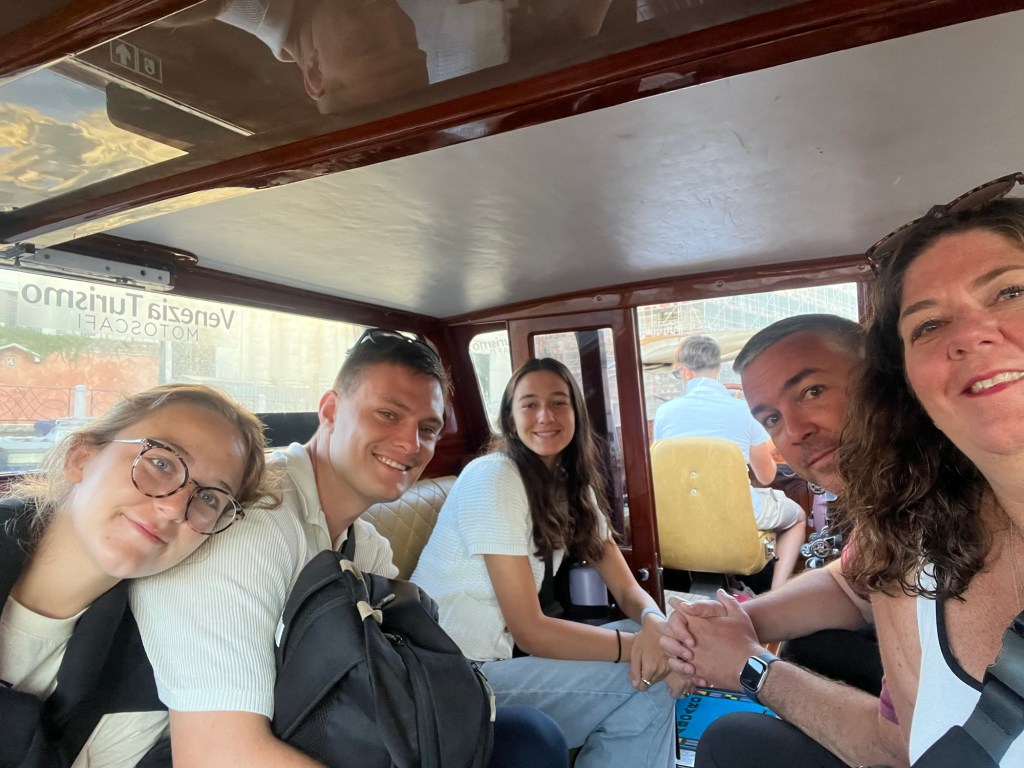
    We friggin took a boat to the airport. How cool is that?! I feel like that’s a pretty fitting way to wrap up an amazing trip to Italy. We all made it back to our respective homes despite some delays due to weather in and around Atlanta.

    That unique mode of transportation is a great segue to some final thoughts from my first time traveling outside of North America. In no particular order:

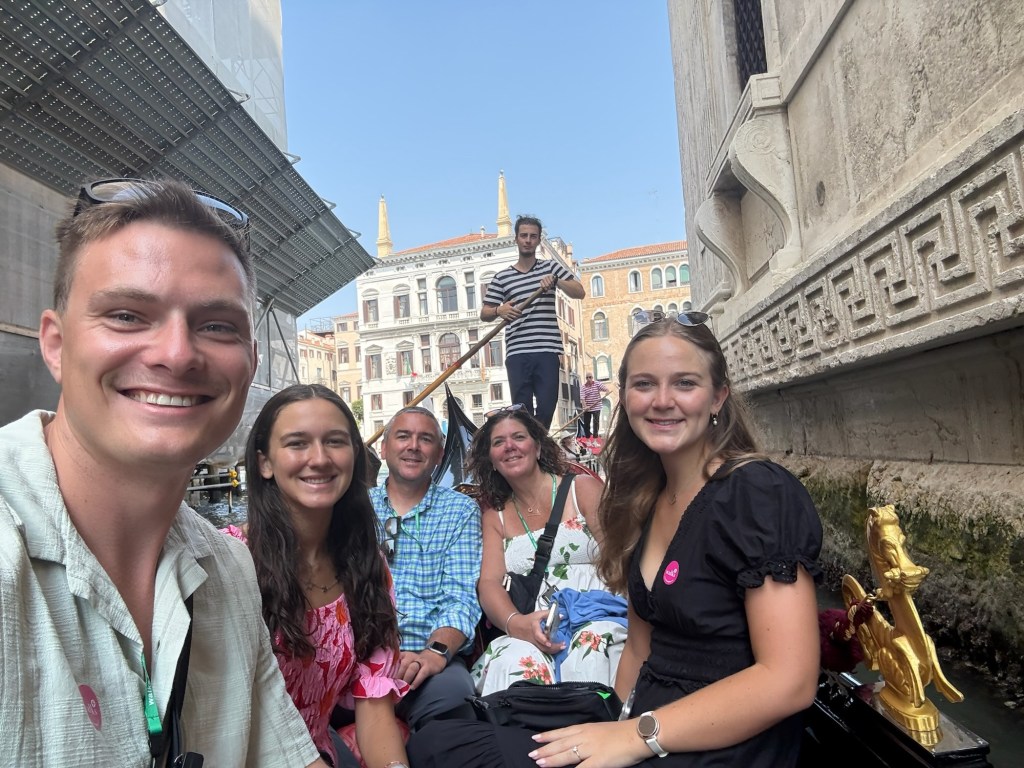
    • In nearly two weeks in Italy, we were in a car a grand total of two times: to get to our flat from the Milan airport and a taxi ride in Florence to catch the sunset. The public transportation system in Europe is something we should emulate here. In addition to walking just shy of 1 million steps between the five of us, we also utilized high speed trains, regional trains, subways, city buses, ferrys, water taxis, water buses and a gondola for good measure.
    • Buy an Epicka travel adapter and don’t ask questions. They work like a charm and even plug into the plane seats.
    • Don’t over-schedule yourself – we backed way off our original itinerary and still probably did too much. Next time will be a little less scripted.
    • Drivers in Milan have to be seen to be believed. It’s utter chaos and somehow we only saw one minor accident.
    • Three cities, 12 full days in Italy, and not once did any of us ever feel unsafe. Obviously, we took precautions to prevent pickpockets in some of the more crowded areas, but our physical safety was never something we had to worry about. (Well, with the exception of those Milanese drivers I suppose.)
    • At a bare minimum try to speak a little of the language, it goes a long way. Clearly, a lot of folks in other countries have varying degrees of English proficiency, but by leading with their native language you demonstrate you’re at least willing to try. You are in their country after all.
    • If you travel when it’s warm – figure out a hydration plan. You have to ask (and pay for) for water with meals and it almost never comes with ice. On top of 90+ degree temperatures, it was surprisingly humid – even to some of the natives. (Fortunately for us, it was supposed to be even hotter this coming week.) One thing you can take advantage of are the public water fountains found across many of the cities. It’s not the coldest water in the world, but it tasted great and was frequently just what the doctor ordered.
    • Embrace the aperitivo. Plan to eat dinner a little later and find a table in a square. Order a spritz or two and soak in the atmosphere. We were pleasantly surprised to discover this pre-dinner ritual has snacks built into the cost: most places have chips at a minimum, others have flatbread or other small bites.
    • Don’t be afraid to wander. With your smartphone it’s pretty much impossible to get lost. You never know what hidden gem you’ll stumble across.
    • We literally stayed in a flat in what amounted to an alley in Florence and the street was way cleaner – and probably safer – than most big streets in America. Shopkeepers treated the sidewalks like an extension of their stores, sweeping and hosing them down every day. Trash in the streets was almost non-existent in every city we went to. Amazing how taking a little pride in where you live can go a long ways.
    • Travel as light as you possibly can. We had a no checked bags mandate and none of us regretted it for a second. We packed for 5-6 days and did small loads of laundry along the way. Just be prepared to hang up your clothes as dryers generally aren’t a thing. Although our Milan flat had an oven/dishwasher combo that was a sight to behold.
    • Lastly, and I cannot stress this enough, the people were some of the warmest and most welcoming I’ve ever met. Smiling, helpful and willing to put up with our constant mangling of their language, they consistently made us feel at ease despite being more than 4,000 miles from home.

    While it took me more than 50 years to travel abroad for the first time, I can promise you it won’t be my last. I’m so grateful that Kara and I were able to experience it with our two girls and son-in-law.

    I leave you with this from Mark Twain:

    Arrivederci!

  • Day 11 – Murano & Burano

    Day 11 – Murano & Burano

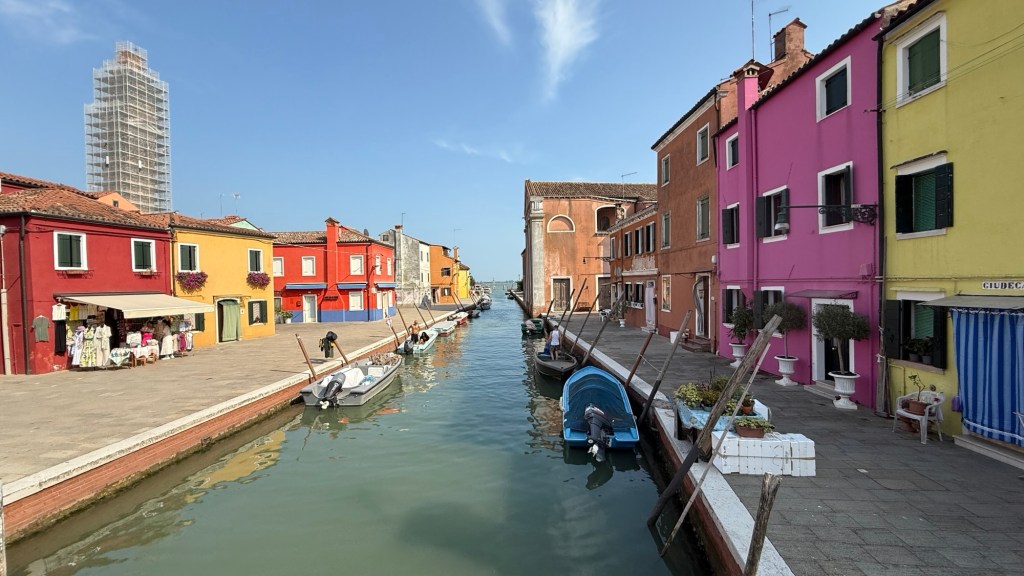
    After a quiet first half of the day spent window shopping and grabbing pizza for lunch, we hopped on a boat and headed for the islands of Murano and Burano. The former renowned for its glassmaking prowess, the latter for its intricate lacemaking and colorful homes.

    Our first stop was the island of Murano, where we witnessed a pair of artisans working their craft in front of a kiln that registered a whopping 2100 degrees Fahrenheit – roughly the same temperature as lava. It was amazing to see the unrivaled level of skill…after a mere 30+ years of practice.

    Unfortunately, we didn’t have too much time for exploring as it was off to neighboring Burano. We managed to console ourselves with a Prosecco toast on the short boat ride over.

    Burano is know for its lacemaking skills that have been passed down from generation to generation. In addition, the colorful houses are not only beautiful, but are used to designate different professions. Blue for fishermen, brown for carpenters, purple for artists, etc. It was also a way for fishermen to identify their houses in inclement weather.

    When we got back on dry land – or at least to Venice proper – we grabbed some take away food and started packing.

  • Day 10 – Doge’s Palace & St. Marks

    Day 10 – Doge’s Palace & St. Marks

    If Florence is magical, Venice is straight out of a fairy tale. No cars, no bikes, no grass – just beautiful and narrow winding streets that abruptly deposit you into a plaza or across one of the hundreds of small canal bridges.

    Oh yeah, and there’s water everywhere. An estimated 10 million trees driven into the floor of the lagoon support the city across its 118 different islands. It’s pretty amazing to think that the construction began more than 1500 years ago. Quite a feat without the aid of modern equipment or building techniques.

    Today was a whirlwind of all things Venice.

    Doge’s Palace

    The Doge’s Palace palace included government offices, a jail and the residence of the Doge (Duke) of Venice – the elected authority of the former republic. It was originally built in 810, rebuilt in 1340 and extended and modified in the following centuries. It includes the famous Bridge of Sighs.

    Basilica di San Marco

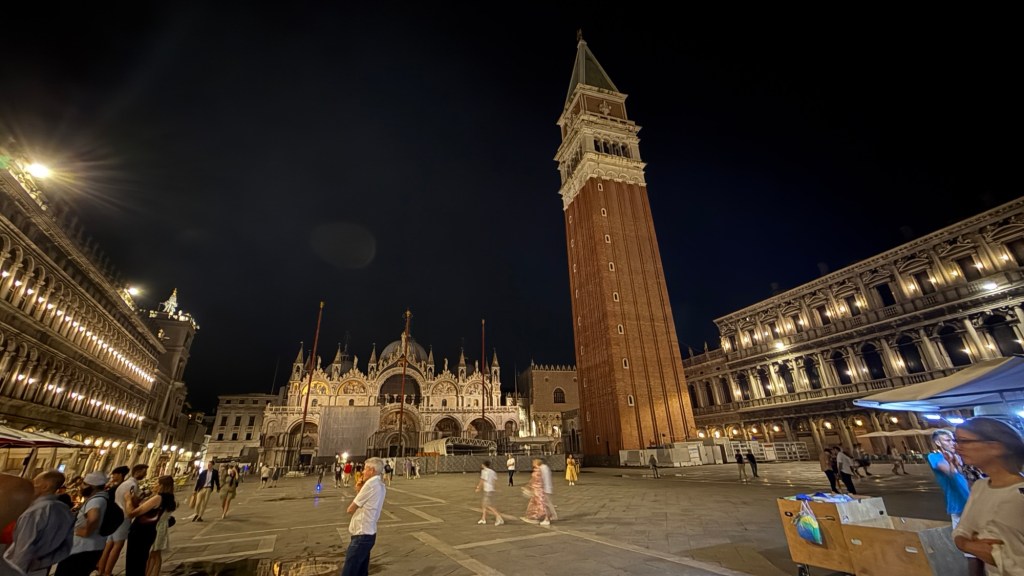
    Saint Mark’s Basilica is dedicated to and holds the relics of Saint Mark the Evangelist (and possibly Alexander the Great?!), the patron saint of the city.

    The church is located on the eastern end of Saint Mark’s Square and the current structure was rebuilt from 1063-1094 on the site of San Pietro di Castello, which was completed in 836.

    Venice, Venice and more Venice

    Presented in no particular order. (Or with no particular context, for now.)

    Caffè Florian

    When the oldest coffee house in continuous operation in Italy (and one of the oldest in the world) is in St. Mark’s Square, you’re required to visit, right? Dessert and a nightcap while listening to beautiful live music in a setting like Caffè Florian is hard to top.

    Fino a domani!

  • Day 9 – Venezia!

    Day 9 – Venezia!

    After a quiet last morning in Florence that involved the stress of eating breakfast and window shopping, we grabbed lunch and headed to the train station to catch a high-speed train to Venice.

    Unfortunately, we had a very low-speed delay of about two hours due to an incident on the tracks between Napoli and Rome.

    We finally managed to check into our flat around 8:00 and quickly went in search of dinner before heading to St. Mark’s square.

    Can’t wait to see what tomorrow has in store for us!

  • Day 8 – Baptistery, Duomo, Palazzo Vecchio & Pasta

    Day 8 – Baptistery, Duomo, Palazzo Vecchio & Pasta

    This morning we reunited with our fearless tour guide, Siro, to tackle Florence’s most notable buildings after touring the major museums three days ago. Needless to say, the Baptistry, Duomo (and accompanying museum) and Palazzo Vecchio did not disappoint.

    Baptistery of St. John

    The Baptistery was originally built in the 5th century, although the marble veneer is “only” 1,000 years old. You can still see the tile from 2nd century Roman houses underneath the current floor.

    Cathedral of Santa Maria del Fiore

    It is utterly impossible to do the Cathedral of Santa Maria del Fiore justice through photos – it has to be seen in person to comprehend the sheer size and and the engineering genius it took to complete the structure.

    Construction on the 500 foot long, 375 foot tall duomo started at the end of the 13th century, but came to a standstill in the early 1400s when no one could figure out how to build a dome to fully enclose the structure. So on August 19, 1418, a competition was announced for a design to complete the seemingly impossible task. Luckily for Florence – and the rest of the world – Filippo Brunelleschi submitted the winning plan.

    His idea was to actually place not one, but two domes atop the cathedral’s 24-foot thick stone walls. The interior dome would have 16 interior ribs for support, while the exterior would have eight additional ribs which are visible from the outside. The architectural marvel was built in a mere 28 years. (For way more information than I’m capable of providing, read Ross King’s Brunelleschi’s Dome: How a Renaissance Genius Reinvented Architecture.)

    The Crypt of Santa Reparata

    Underneath the Duomo lies the Crypt of Santa Reparata, the site of a couple previous churches on the site dating back to the 5th century. You can also see Brunelleschi’s tomb, the altar from the previous church, centuries-old Roman mosaic tile that are still intact and for all you fundraisers out there – a list of prominent donors who helped construct the previous church.

    Museo dell’Opera del Duomo

    About 10 years ago, the stunning Museo dell’Opera del Duomo was opened to basically showcase all the items that had previously been stored in the “attic” of the Duomo and Baptistery. Here are just a few of the highlights.

    Palazzo Vecchio

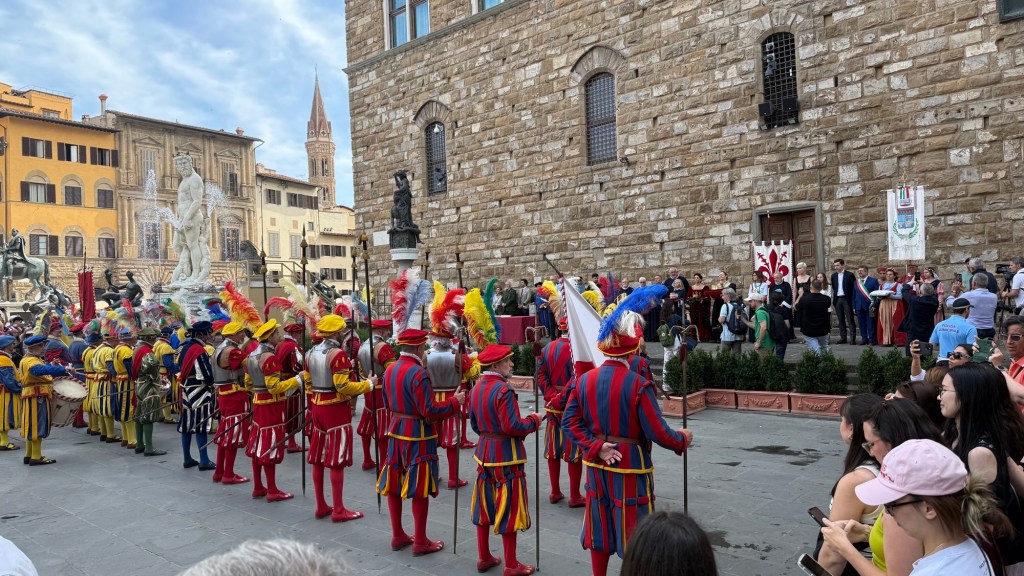
    Palazzo Vecchio was first built in 1300s and added onto over the next couple of centuries. Let’s just say the Medicis weren’t hurting for money. It now serves as the town hall for Florence.

    Pasta Making!

    We booked a pasta making class to cap off our last full day in Florence. Amazingly, we were paired with a Philadelphia couple celebrating their 25th anniversary (Kara and I just celebrated number 26 in Milan) and their two daughters – one of whom is starting college in the fall to become a teacher. You can’t make this stuff up.

    The food and wine were great – the former despite our best efforts – but the company was even better. Salute!

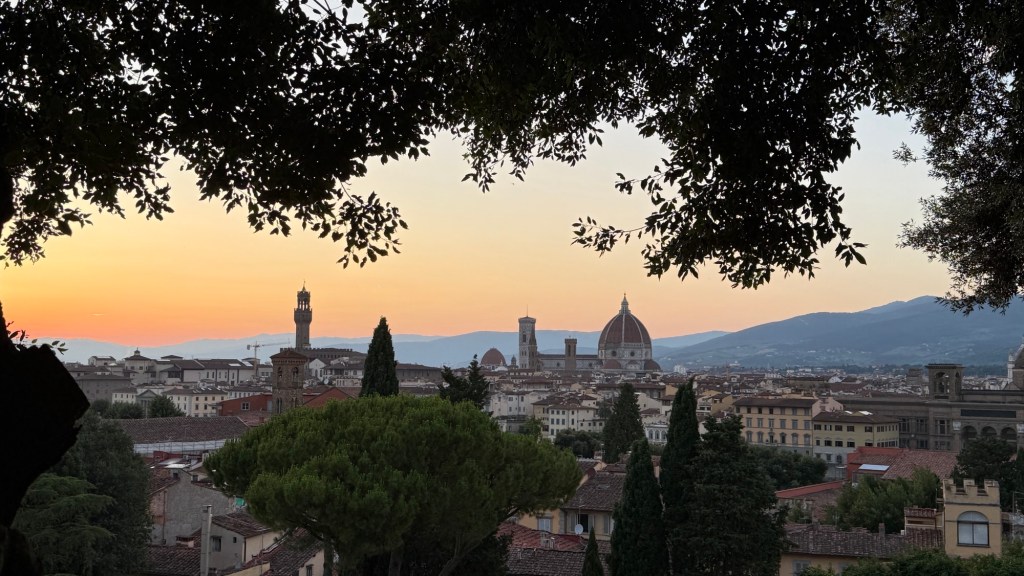
    Sunset at Piazzale Michelangelo

    There truly is no better view than to catch the sunset from the Piazzale Michelangelo high atop the hills above Florence. A great way to cap our last night in this beautiful city.

  • Day 7 – Our “Free” Day

    Day 7 – Our “Free” Day

    When I was thinking this morning about today’s recap, I was worried it might be a short post because we didn’t have anything officially slated for the itinerary. But it turns out in Florence, when you don’t have anything to do, you end up walking more than 20,000 steps (putting each of us at well over 100,000 for our first seven days in Italy) and filling the day up from 9 am to 11 pm.

    I’m still not going to write a whole lot as we’re all pretty exhausted. I’ll just let the pictures (and video) do the talking.

    Morning Kayak on the Arno

    Palazzo Pitti

    Because Eleonora di Toledo wanted a garden, the Medicis moved from Palazzo Veccio to Palazzo Pitti in the mid 1500s.

    End of the day libations & food

    Tagliatelle flambé al tartufo fresco in crosta di Grana Padano. The famous cheese wheel at Osteria Pastella.
    As good as it looks!

    Good night from Florence!

  • Day 6 – Cinque Terre

    Day 6 – Cinque Terre

    Map of Cinque Terre

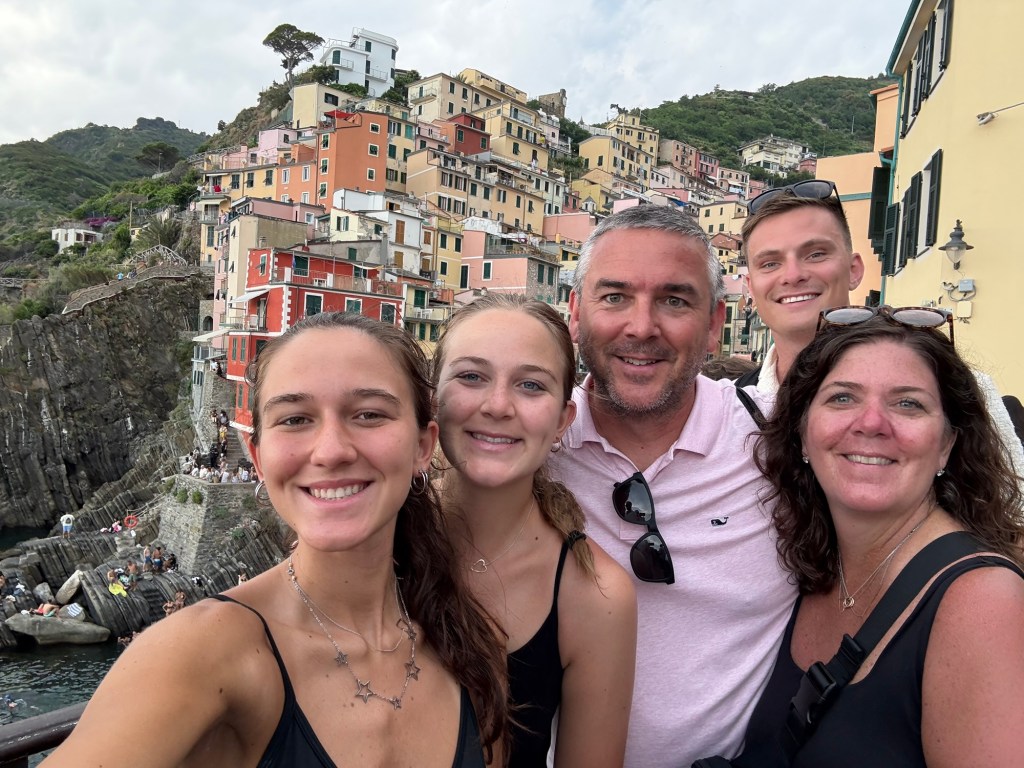
    Like nothing I’ve ever seen before. That’s the best way to sum up our day visiting the five towns that make up Cinque Terre – a UNESCO World Heritage Site along the west coast of Italy.

    From Florence we hopped on a bus for the roughly two-hour ride to the La Spezia train station, crossing the beautiful Italian countryside.

    Accessible only by train – or by walking – each town is nestled in separate impossibly steep valleys that come to a crashing halt at the edge of the Ligurian Sea. Each a postage stamp of color and vibrancy in their own unique way.

    To avoid the morning crowds, we started at Manarola and were immediately enchanted. From there, we took the train to successive stops in Corniglia, Vernazza (of the movie Luca fame) and Monterosso al Mare. [In full disclosure, Kaitlin, Madeline and David hiked the mile-and-a-half between stops 2 & 3 in the 85°, 85% weather. After all five of us climbed the 376 steps to get to Corniglia.]

    After checking out the sights in Monterosso, we took a boat ride down the coast to Riomaggiore that allowed us to view each town in succession from a completely different vantage point.

    The Cinque Terre region is know for its seafood (obviously) and one-of-a-kind pesto that includes potatoes and green beans among the more traditional ingredients. Fortunately, we were able to enjoy both as part of the tour.

    As an aside, “farm to table” isn’t a marketing slogan in Italy, it’s basically every meal. The seafood was unbelievably fresh and the pesto pasta was full of rich flavor.

    As we head back to Florence sunburned and tired – but buoyed by an unforgettable day, we already can’t wait to see what tomorrow holds.

    Buona notte.

  • Day 5 – Uffizi & Accademia

    Day 5 – Uffizi & Accademia

    First off, a shoutout to our guide for today, Siro Chini. I’ll let you figure out which one he is. (Apologies for the [cough] awkward angle.)

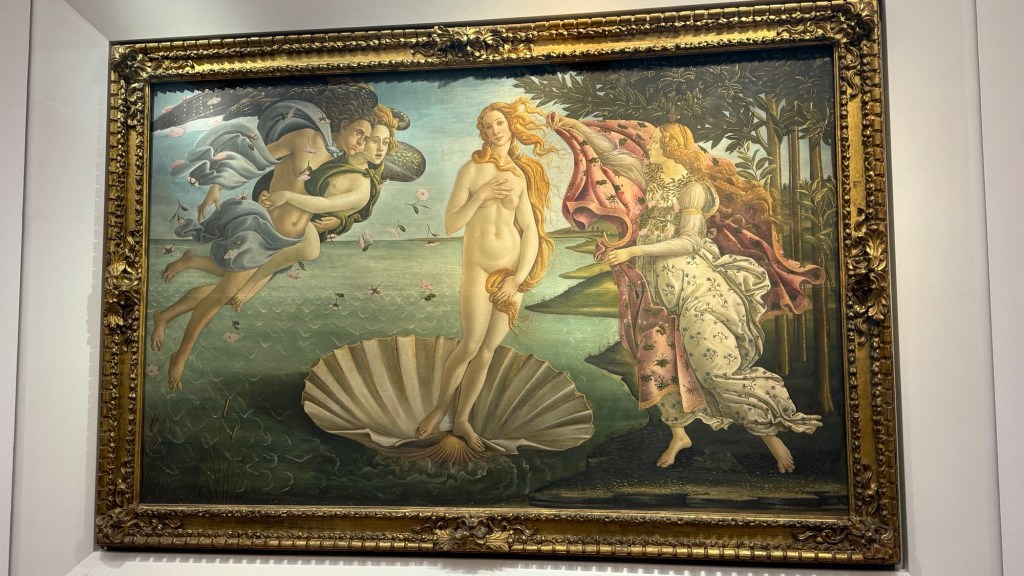
    My goodness Florence, stop it. In the span of about four hours, we saw some of the most amazing art ever created. We started at the Uffizi Gallery, the former administrative offices of the Medici. Here’s just a small sampling:

    And the two showstoppers from Botticelli:

    Primavera
    Birth of Venus

    After a quick pit stop for lunch, we headed to the Galleria dell’Accademia to check out maybe the second most famous piece of art in the world (feel free to check me on this).

    We rounded out the day’s exploring by checking out the Medici family church, the Basilica of San Lorenzo:

    Because, you know…the Duomo isn’t just a few steps away.

    And because all that art wasn’t enough, the five of us also took turns making marbled paper at Riccardo Luci Firenze – highly recommend (more photos to come).

    We then capped out a great, but somewhat exhausting traversing some of Florence’s most amazing sights in the 90+ degree heat with a wonderful al fresco meal in the inviting shade and misting hoses of Hosteria Ganino. Needed to turn in early for tomorrow’s adventure!

  • Day 4 – Parma & Florence

    Day 4 – Parma & Florence

    Hopped on a high-speed train for Parma this morning cruising along at 250 kph. Here’s how that converts to miles: the United States needs to rethink the way it looks at transit. Instead of spending almost two hours battling Italians who drive like they’re angry at the road, we transversed the 80 miles in 50 minutes of peaceful bliss.

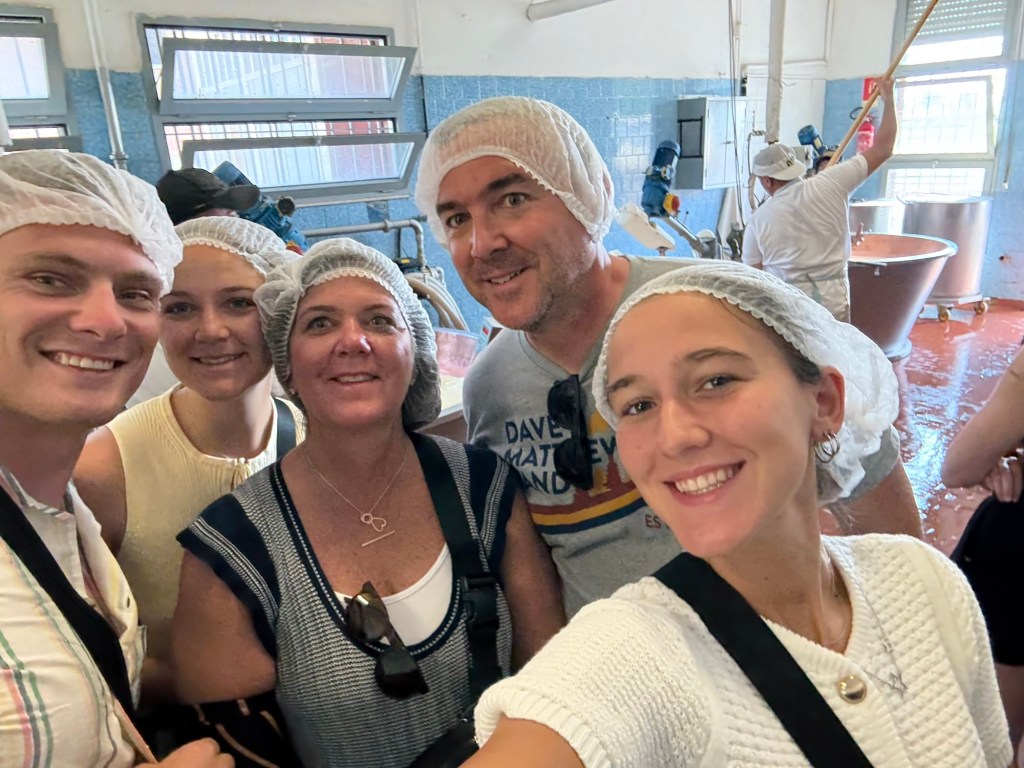
    Parma was a nice change from the bustle of Milan. We visited Caseificio Ugolotti for a tour and tasting of their delicious parmesan reggiano. After that we headed into the city center for lunch – where David narrowly avoided eating horse (!!!) – and a quick visit to the Duomo di Parma, which completely caught us off guard with its amazing interior.

    And then off to Firenze! But only just barely, as our regional train to Bologna was running late and we managed to make it to our high-speed train to Florence about 90 seconds before it left the station.

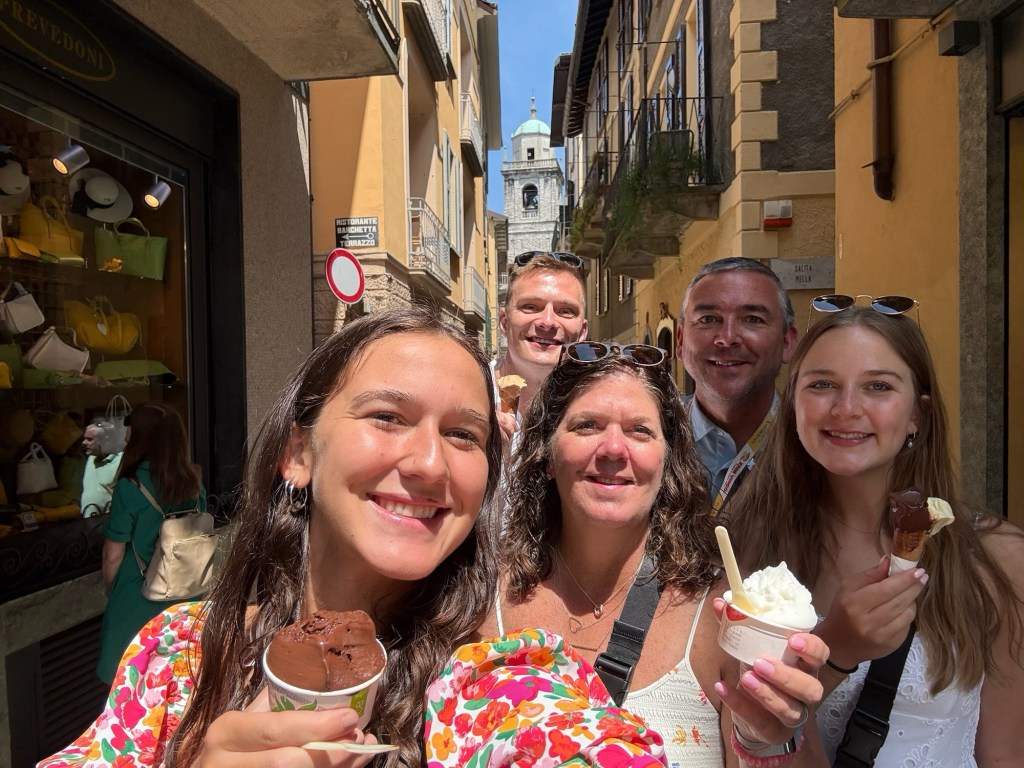
    We’re really fortunate that our lodging is just a block off the Arno River and pretty much anything you want to do or see in the city is within a 10-minute walk. The vibe here is unlike anything we’ve ever experienced before.We had a wonderful dinner last night at Buca Mario (highly recommend), where Kara and I were fortunate enough to share our 26th anniversary with the kids, some limoncello and of course, gelato. Can’t wait to start exploring tomorrow!

  • Day 3 – Lake Como

    Day 3 – Lake Como

    Today we headed about an hour north of Milan to check out Lake Como. While it was as beautiful as advertised, it was also crowded and many of the roads on the west side of the lake are barely one lane (at best) which was quite the interesting experience on a tour bus.

    One of the highlights was being able to see the Swiss alps – which tower more than 11,000 feet above the north end of Lake Como. The 5,000 foot peaks in the foothills are known only as the “pre-Alps.”

    In addition to a cruise on the lake, we were able to wander the streets of Bellagio and Como before heading back to Milan to catch a quick dinner and pack for the next leg of our trip tomorrow.